Showing posts with label S. Show all posts
Sunday, June 10, 2012 | By: rudi butt

First Man Killed By Shark


Updated (partial) on August 19, 2012

Reg Harris [1], special (war) correspondent for several journals in Australia who was based in Hong Kong, filed the following report on September 25, 1945 for The Argus (Melbourne, 1846-1957).
Man Killed by Shark at Hong Kong

Police-sergeant H.W. Jackson [2] was the victim yesterday of the first known shark attack at Hong Kong while he was bathing at Tweed Beach [3] shortly before dusk. He was frightfully mauled and died within a minute of being rescued by Captain A.M. [sic] Braude [4], Hong Kong Volunteer Defense of the Hong Kong Telephone Company.
Tweed Beach is a popular swimming area near Stanley internment camp. Sergeant Jackson, who was interned for nearly four years, was awaiting repatriation to London.
Large sharks have never been seen in Hong Kong bathing waters. It is believed that this one must have followed a ship in.

Jim Vine and Reg Harris (right), both war correspondents
Pacific Area 17, Philippines, December 8, 1944
Photo by Clifford Bottomley
Source: Trove
[1] Reginald Leslie Harris was war correspondent for a number of Australian media, including Australia Morning Press, Sydney Telegraph, Melbourne Sun Pictorial, and Courier Mail. He was one of the first journalists to return to Hong Kong after its liberation in August 1945. Harris later became press secretary to several Federal Ministers in Australia. Books written by Harris have included Legendary Territorians, in which he told stories of 70 pioneers in the Alice Springs region, Northern Territory.

Police sergeants lined up at medal presentation
Central Police Station 1939
Source: Hong Kong Police Force
(Might one of them be Sergeant Jackson?)
[2] Herbert W. Jackson was a lance sergeant in the Hong Kong Police Force. There was a conflicting record that said he died on April 5, 1942 whiled interned.

[3] Tweed Beach, or Tweed Bay, refers to Pak Sha Wan 白沙灣 in Stanley (not to be mistaken with Hebe Haven in Sai Kung, which is also called Pak Sha Wan). The islet across the bay is called Tweed Island, or Lo Chau 羅洲. According to the Survey and Mapping Office of the Lands Department, there was no record that shows why Pak Sha Wan was called Tweed Bay, and Lo Chau - Tweed Island. “The earliest map found showing the name, “Tweed I.” (Tweed Island) is Sheet 23 of the 1:20000 map series GSGS 3868 published by the War Office in 1938. While the name “Tweed Bay” may also have existed by that time but not shown on the same map due to limited map space, our earliest map found showing the name “Tweed Bay” is the 1:600 survey sheet no. 248-NE-10 published by the Crown Lands and Survey Office in 1969.”, said the Survey and Mapping Office in reply to my email inquiry. I found a seperate reference in the British Army Order of Battle of 1939 that on September 3, 1939, the 4th Battery of the Hong Kong Volunteer Defense Corps was deployed at Pak Sha Wan; the record made no reference to the Tweed Bay naming. Incidentally, a new nickname for the island -- 棟頭洲 (Dung Dou Chau) appeared in 1940. Had this new nickname anything to do with the “Tweed” naming? Probably, but honestly, I am not going to spend any time on this further.

[4] Arthur Nathaniel Braude (b. February 1, 1902 – d. June 16, 1969) hailed from Edinburgh. He attended the George Heriot's School at Lauriston Place. Braude came to Hong Kong no later than 1928 (his name appeared for the first time on the common jurors list No.3 of 1928) and was an engineer with Hong Kong Telephone Co., Ltd. Before long after arriving here, he joined the Hong Kong Volunteer Defense Corps. His appointment to second lieutenant from a NCO in the Corps Machine Gun Battalion's Signal Section on April 12, 1935 was announced in the Government Gazette of May 3, 1935 (item #341). Braude became a captain no later than 1941 and, during the Battle of Hong Kong, was in command of HKVDC's Signals Corps, which was comprised of two officers (he and a second lieutenant named Alan Dudley Coppin) and thirty eight men. Upon the surrender of the British forces in Hong Kong, he was imprisoned at the Shamshuipo POW camp. He received an Efficiency Decoration and was made a major after the war, and on June 1, 1953, on the occasion of the coronation of Queen Elizabeth II, appointed to the Most Excellent Order of the British Empire (M.B.E.). Braude's wife, Irene, was head of the Voluntary Aid Detachments. She commanded the Nursing Detachment 1, which was comprised of three officers (herself including) and 126 nurses. Irene Braude, daughter Patricia Braude, and her parents, Stuart Deacon (b. April 15,1885 – d. April 24, 1942) and Florence Maude Deacon (b. September 9, 1888 – d. December 12, 1962), were kept at the Stanley internment camp (designated for civilians). Both Braude and his wife suffered from amoebic dysentery as a result of their internments. Stuart Deacon died during interment at the Tweed Bay Hospital (room 419). He came to Hong Kong no later than 1922 and worked for the Hong Kong Electric Company as an electrical engineer; he retired months before the Battle broke out. 
Released British internees from Stanley Camp
being issued with tickets to board a troopship
that will carry them to England.
Photo by: Sergeant R. Watson. Source: Imperial War Museums
Arthur and Irene Braude were there on the beach when the shark attacked Jackson and they helped pull him out of the water. Irene Braude said he died from loss of blood. A story in the South China Morning Post of September 24 reported that Jackson was killed by a shark on Sunday, the 23rd. There was however a different report of a shark attack: Police Lance Sergeant H.M. Goldie of the No.8 Police Station (located at the corner of High Street and Bonham Road) was bitten by a shark or a large fish and bled to death soon after the Japanese surrender (the surrender took place on August 15). Additionally, a notice appeared in the South China Morning Post of September 29 put Goldie's name on the list for ex-internees to be repatriated 'on or about Tuesday next', i.e. October 3. The only repatriation ship (for civilians and uniformed civilians) I found that left around that time from Hong Kong was HMT Highland Monarch that sailed on October 5. A little bit of confusion there that I hope one day will become clear.

I found this brief description of Jackson's shark attack in Stanley written by Second Lieutenant John Dickson, a pilot with the 812 Naval Air Squadron who arrived Hong Kong on September 5 on board the brand new carrier HMS Vengeance (R71).

Bill Williams (first left), John Dickson (second left)
Kai-tak Airport, November 1945
Source: hms-vengeance.co.uk.
"I had a couple more trips out to Stanley and on the 23rd September went there by bus with Bill Williams (an observer serving on Dickson's Fairey Barracuda dive bomber 381/A PM 757). We enjoyed swimming with the girls (twin daughters of Dickson's family friends who lived in Hong Kong) but were horrified to learn that one of the male ex-internees who had been on the beach at about the same time, was attacked and killed by a shark soon after we left. A tragic end after 4 years in captivity. Needless to say we didn't go swimming for the rest of our stay. The twins and their mother sailed home on the "Highland Monarch" a couple of weeks later."


Fatal Shark Attacks In Hong Kong Waters

1991
- June 7 (Friday), 65-year-old woman, Yeung Tam-ho, was attacked while swimming at Silverstrand Bay 銀線灣 in Sai Kung.
- June 28 (Friday), 22-year-old man was attacked while swimming off Basalt Island, or Fo Shek Chau 火石洲 in Sai Kung.

1993
- June 1 (Tuesday), 42-year-old man was attacked while swimming near Sheung Sze Wan 相思灣, a part of the Clearwater Bay 清水灣 in Sai Kung.
- June 12 (Saturday), 61-year-old man was attacked while swimming at Silverstrand Bay.

1994
- Exact date to be verified, a woman was attack while playing beach volleyball (she probably went in the water to fetch the ball), location to be verified.

1995
- June 1 (Thursday), 44-year-old man, Tso Kam-sun, was attacked during a scuba diving session at Silverstrand Bay.
- June 2 (Friday), 29-year-old man, Herman Lo Cheuk-yuet, was attacked while swimming near Sheung Sze Wan.
- June 13 (Tuesday), 45-year-old woman, Wong Kui-yong 王桂容, was attacked while swimming at Clearwater Bay.

All fatal attacks took place in Sai Kung, only in the month of June, and favored Tuesdays and Fridays in particular. I am still looking for attacks (if any) between 1946 and 1991. No shark attacks in Hong Kong waters were reported since June 13, 1995.

A Tiger Shark, an illustration by Jane Kim
Source: Lost at E Minor (website)
Shark Sightings In Hong Kong Waters

The first ever recorded shark sighting was reported by the Friend of China in its August 17, 1843 issue. Sharks were sighted in the Victoria Harbor.

15 sightings between 1991 and 2006 were reported; they took place in Tuen Mun, Repulse Bay, Deep Water Bay, and Hoi Ha Wan, Clearwater Bay, Little Palm Bay, Silverstrand Beach and Sheung Sze Wan in Sai Kung. These are what I found since 2006, with some particular information:

- April 2006 – Cafeteria New Beach, Tuen Mun, unidentified and unconfirmed.
- September , 2006 – off Shek O Beach, 2 gray reef sharks.
- Wednesday, June 6, 2007 - off Pak Sha Wan (Hebe Haven), Sai Kung, 4 tiger sharks were sighted.
- Wednesay, June 20, 2012 - off Stanley Main Beach, unidentified 2-meter-long fish with gray fin, unconfirmed.
- Tuesday, July 3, 2012 - off Deep Water Bay, unidentified and unconfirmed.

- TO BE COMPLETED -


References:
- ADF (Australian Defense Force) Serials Newsletter, November 2003.
- The Argus (Melbourne), Tuesday, September 25, 1945, p.20.
- Australian War Memorial [internet].
- The Boys in Blue: A HKP Chief Inspector. & A.P.I., September 2007 [internet].
- The Dedication and Unveiling of the Repatriation Memorial, Pier Head, Liverpool, Saturday October 15, 2011, A Brief History and Order of Service.
- Dickson, John, H.M.S. Vengeance, 812 Squadron in Hong Kong (5th September - 28th December 1945) [internet].
- Emerson, Geoffrey Charles, Hong Kong Internment, 1942-1945, Life in the Japanese Civilian Camp at Stanley, Hong Kong: Kong Kong University Press, 2008.
- Emerson, Geoffrey Charles, Tweed Bay Beach, Stanley Camp Discussion Group discussion list, March 12, 2012 [internet].
- Hong Kong (& Macau) Stuff, The Sai Kung Shark Attacks - early 90's, Sai Kung [internet].
- Hong Kong Government, Civil Engineering and Development Department, Glossary of place names [internet].
- The Hong Kong Government Gazette, May 3, 1935, No.555.
- Hong Kong Police Force [internet].
- Hong Kong War Diary, Hong Kong's Defenders, Dec 1941 - Aug 1945, Civilians. [internet].
- Hong Kong War Diary, Hong Kong's Defenders, Dec 1941 - Aug 1945, Uniform Civilians. [internet].
- Hong Kong War Diary, Hong Kong's Defenders, Dec 1941 - Aug 1945, Hong Kong Volunteer Defense Corps. [internet].
- Jurors List for 1922, No.2 of 1922; 1928, No.3 of 1928; 1940, No.3 of 1940, Hong Kong.
- List of Heroters Who Served in the World War 1939-1945, George Heriot's School.
- London Gazette, June 1, 1953, Supplement.
- Map Information Section, Survey and Mapping Office, Lands Department, Origins of the names of Tweed Bay and Tweed Island, June 20, 2012 [email, to Butt, Rudi][internet].
- Naval History, Admiralty War Diaries of World War 2, British Pacific Fleet - August to September 1945 [internet].
- South China Morning Post, September 17, 2006.
- Stanley Camp Discussion Group [internet].
- Trove Digitised Newspapers [internet].
- United States Army Combined Arms Center, ‎Combined Arms Research Library, Nafziger Documents, British Armed Forces [internet].
- yoSurfer, Hong Kong All Shark attacks [internet].

Thursday, November 26, 2009 | By: rudi butt

Famous Scotsmen in Hong Kong


Updated (partial) on September 5, 2012

Here are some of the more familiar names, ...

Robert Black
Robert Black 柏立基

b.1906, Edinburgh – d.1999, Reading, Berkshire; 23rd Governor of Hong Kong (1958-1964); educated at George Watson's College, University of Edinburgh; entered Colonial Service after school and was stationed in Malaya and Trinidad; commissioned into the Intelligence Corps assisting in guerrilla resistance against Japanese in North Borneo, captured by the Japanese in 1942 and spent the remainder of WWII in prison camp in Malaya; Colonial Secretary of Hong Kong (1952-1955); 3rd Governor of Singapore (1955-1957). Major events took place during his tenure as governor: economic boom led by rapid growth in the manufacturing sector; large influx of illegal immigrants from China and the introduction of “Government Low Cost Housing Scheme” in 1962; severe drought while at worst in June, 1963, water available for only 4 hours once every 4 days; the opening of the City Hall and the first Public Library (first city hall built on public funding); the establishment of the Chinese University of Hong Kong in 1963.

1893 photo of James Cantlie teaching at the
Hong Kong College of Medicine for Chinese
James Cantlie 康德黎

b.1851, Banffshire - d.1926, London [1]; came to Hong Kong to take up position as Dean of the Hong Kong College of Medicine for Chinese in 1888, taught Dr. Sun Yat Sen (graduate of 1892), co-founded the British Medical Association (Hong Kong Branch) in 1890, led a campaign in releasing Dr. Sun who was kidnapped in London by Qing China officials in 1896, returned to London to practice in 1897, established the Journal of Tropical Medicine in 1898, founded the London School of Tropical Medicine in 1899, founded the Society of Tropical Medicine and Hygiene in 1907, authored “Physical Efficiency” (published in 1906) and co-authored “Sun Yat Sen and the Awakening of China” (published in 1912), authored the first British Red Cross first aid, training and nursing manuals in 1911.
[1] Obituary (Nature*, June 12, 1926) - Sir James Cantlie, K.B.E.

The death on May 28 of Sir James Cantlie, at the age of seventy-five years, removes from our midst a man of originality and untiring energy, and a ready writer and speaker. In his early days he was demonstrator of anatomy and assistant surgeon and later surgeon to the Charing Cross Hospital, but most of his life work outside his practice, whether in London, Hongkong, or again in London, was devoted to teaching and pioneering in unexplored fields of medical education.

*Nature is an international weekly journal of science that began to publish in 1869)
John Cowperthwaite, praised as the architect of
Hong Kong's prosperity
John James Cowperthwaite 郭伯偉 (1915 Edinburgh -2006 Dundee)

Economist, Financial Secretary of Hong Kong (1961-1971), responsible for creating Hong Kong's dynamic economy. Education: Merchiston Castle School, read classics at the University of St. Andrews and Christ's College (Cambridge) before returning to St. Andrews to study economics, under the influence of Wilkie Nisbet (1903-1974); joined the Colonial Service in Hong Kong in 1941, but spent three years in Sierra Leone while Hong Kong was occupied by the Japanese; returned to Hong Kong at the end of the WWII to assist in economic recovery, rising to become Financial Secretary in 1961; a champion of laissez-faire economics, he removed import and export controls, and balanced the colony's budget, while reducing taxes and encouraging the natural entrepreneurship of the Hong Kong people; his lack of intervention and promotion of free enterprise has been criticized principally because of growing corruption, poor social services and the lack of housing for immigrants, although the export success of Hong Kong's businesses certainly reduced poverty; retired in 1971 and lived in St. Andrew; served as an international advisor to Jardine Fleming, the Hong Kong-based investment bank (1971-1981). This was written as the introduction of the February 3, 2006 article on The Times praising Cowperthwaite:
“On Hong Kong’s reversion to Chinese rule, its foreign reserves stood at about $70 billion — half the amount held by China, yet accrued by a population less than 1 per cent its size…, the legacy of John Cowperthwaite,”
William Jardine

Johnston and pupil, Puyi
Reginald Fleming Johnston (1874 Edinburgh - 1938 Edinburgh)
Assistant Colonial Secretary (1899-1904) (Henry A. Blake was governor); educated at Edinburgh University and Magdalen College, Oxford; recruited as a 'cadet officer' in the Colonial Service after graduated; joined Hong Kong Civil Service in 1898; transferred to Weihaiwei in 1906 and became Senior District Officer and Magistrate until 1917; became Tutor of Puyi, the last Emperor of China in 1919 until Puyi was expelled from the Forbidden City in 1924; appointed Commissioner of Weihaiwei (1927-1930); appointed Professor of Chinese and Head of Department of Languages and Cultures of the Far East, School of Oriental Languages, London University (1931-1937).

William Keswick

Douglas Lapraik
Douglas Lapraik (1818-1869)

Came to Hong Kong in 1843 and worked as a watchmaker apprentice, became opium dealer soon after, started building docks in Aberdeen in 1857, became a member of the Provisional Committee of the Hong Kong and Shanghai Banking Company Limited in 1864, founded the Hong Kong, Canton and Macao Steamboat Company in October 1865, co-founded the Hong Kong and Whampoa Dock Company with Thomas Sutherland in 1866, member of the inaugural Board of Directors of the Hong Kong Hotel Company in 1866, founding member of the Hong Kong Chamber of Commerce, donate town clock installed at the Pedder Street Clock Tower, owner of the Douglas Lapraik Castle (now the University Hall of Hong Kong University), owner of the Chinese Junk Keying which Lapraik had organized its fantastic voyage to London in 1846.


James H.S. Lockhart
James Haldane Stewart Lockhart 駱克 (1858 Argyllshire, Scotland – 1937 London)

A British colonial official in Hong Kong and China for more than 40 years; praised as one of the most intelligent, efficient, and scholarly colonial secretaries that Hong Kong has had; educated at King William's College (1868-72) and the University of Edinburgh; took a Hong Kong cadetship in 1878; arrived Hong Kong in 1879; appointed Superintendent of the Opium Revenue in 1883; Assistant Colonial Secretary and Assistant Auditor-General in August of the same year; Acting Registrar-General in 1884 and 1885; Registrar-General in 1887, a post he occupied until 1901; and Colonial Secretary in 1895, a post he combined with that of Registrar-General; appointed Rector of the College of Medicine for Chinese in 1895; appointed representative of the Government of Great Britain for the purpose of fixing the exact boundaries of the extension of the New Territories in 1899 and the subsequent occupation of the district; established civil administration headquarters for the New Territories in Tai Po; assumed the post of Civil Commissioner of Weihaiwei in 1902, one that he held for the next 19 years; well respected by the Chinese communities in Hong Kong and in Weihaiwei; became a noted sinologist after retiring from the colonial service; remembered by naming of Lockhart Road 駱克道 in Wanchai.

MacDougall during the escape
from Hong Kong
David Mercer MacDougall 麥道高 (1904 – 1991)
Brigadier Colonial Secretary (1945-1949): Cadet Officer in Hong Kong, seconded to the Colonial Office in London in 1937; assigned to the Ministry of Information and sent back to the colony shortly before the Battle of Hong Kong; escape from Aberdeen in HMS Cornflower’s motor launch before joining up with the 2nd MTB Flotilla on the South West of Ap Lei Chau; appointed head of the Hong Kong Planning Unit (established in London in August 1943, and eventually incorporated into the armed forces as civil affairs staff) in 1944 and given the rank of Brigadier; arrived back to Hong Kong in 1945 assisting Cecil Halliday Jepson Harcourt (Admiral, RN, Military Governor, Hong Kong from September 1945 to April 1946) in looking after civil administration; assumed the post of acting Governor from May to July in 1947, and the Governor’s Deputy in 1948.

Duncan MacIntosh
Duncan William MacIntosh 麥景陶

15th Commissioner of Police (1946-1953), seasoned senior officer with experience in Ireland and Malaya, a POW during WWII, was the acting Police Commissioner in Singapore prior to the appointment in Hong Kong, was very well respected for reorganizing the Kong Kong Police Force after WWII, for improving the remuneration and working condition of police personnel, additionally, he began building living quarters for the rank and file personnel in the force; the Hong Kong Police Force Pipe Band, established in 1954, adopted the color of Macintosh tartan in his memory; he was also famous for ordering the construction of a group of seven observation posts (built between 1949 and 1953) along the Shenzhen River at the border with China, dubbed MacIntosh Forts [2] 麥景陶碉堡 or Macintosh Cathedrals, the posts were built at a time when an influx of Chinese refugees from China and armed clashes between the police and refugees occurred.

Andrew Mackay
Andrew Mackay (Major General)

Scottish army officer installed as Governor of Edinburgh Castle on June 19, 2009, started his career as an Inspector in the Royal Hong Kong Police in 1979, commissioned into The King's Own Scottish Borderers (KOSB) in 1982, promoted to general staff in1990. (I have to qualify that Major General Mackay is not very well-known in Hong Kong.)

Murray MacLehose

Jimmy McGregor
Jimmy McGregor 麥理覺

Came to Hong Kong in the early 1950s, Director of the General Chamber of Commerce of Hong Kong (1975-1988), established McGregor & Co in 1988, member of the Legislative Council as Chamber Legislative Council Representative (1988-1995), founding member of the Hong Kong Democratic Foundation 香港民主會, which was established in 1989, initially critical on Chris Patten's (the last colonial governor) Electoral Bill presented for voting in the Legislative Council in 1995, but changed course later on by voting for it, became close ally of Patten, appointed member of the Executive Council (1995-1997), left Hong Kong in 1997.

Patrick Manson
Patrick Manson 梅森 (1844 Aberdeenshire - 1922 London)

Parasitologist and pioneer of the tropical medicine, practiced medicine in Hong Kong between 1883 and 1889; education: University of Aberdeen (MB ChB in 1865, Ch.M. in 1866, MD and LL.D. also in 1866); went to Taiwan in 1866 to work for the Qing Chinese Imperial Maritime Customs, moved to Amoy (Xiamen) in 1871 to avoid armed conflict between China and Japan in Taiwan; imported 80 dairy cows from Scotland to Hong Kong and in 1886 established a dairy farm in Pok Fu Lam and the company Dairy Farm (牛奶公司) [4], co-founded the Hong Kong College of Medicine for Chinese in 1888, became Chief Medical Officer of the Colonial Office in London in 1897, became the first president of the Royal Society of Tropical Medicine in 1907, taught at the London School of Tropical Medicine until he retired in 1914, published his best known work - Tropical Diseases: A Manual of the Diseases of Warm Climates - in 1898.

James Matheson

John Robert Morrison

William Purves
William Purves 浦偉士 (1931 Kelso - )

Chairman and CEO of the Hong Kong and Shanghai Banking Corporation (1986-1993), Chairman of HSBC Holdings plc from (1990-1998), education: Kelso High School; joined The National Bank of Scotland (now The Royal Bank of Scotland) in 1948 as trainee, served in the Korean War and was awarded the Distinguished Service Order (DSO), joined HSBC in Hong Kong in 1954, became the bank's CEO 31 years later and its Chairman the following year, became the first Chairman of HSBC Holdings in 1990, oversaw HSBC's acquisition of Midland Bank in 1992 and hold the position of its Chairman from 1993 to 1998, appointed to Hong Kong Government's Executive Council (1987-1993), retired in 1998 and now lives in London, holds a number of advisory roles in various companies, appointed a Reuters Trustee in 1998, 1980 Chieftain of the Hong Kong St. Andrew’s Society.

Phineas Ryrie 賴里

Senior Partner of the Canton firm of Turner and Co. (a general agency firm and opium-merchant founded by Robert Turner), Senior Unofficial Member of the Legislative Council (1870-1892), inaugural Chairman of the Jockey Club [5], co-founder (with partner Alexander Finlay Smith [b]) of the High Level Tramway Company in 1885 and began building the Peak Tram that ran from Garden Road to Victoria Gap, longest serving officer in the Hong Kong General Chamber of Commerce (5 years as Vice Chairman and 12 years as Chairman), strongly opposed government's plan to legalize gambling in 1868, investor and director of Dr. Patrick Manson's Dairy Farm Company, inaugural Chieftain (1882-1890) of the Hong Kong St. Andrew’s Society (established in 1881)

[5] Chairmen of the Hong Kong Jockey Club 1884-1941: A Succession List

 
Phineas Ryrie1884-1892
Paul Chater1892-1926
H.P. White1926-1929
C.Gordon S. Mackie1929-1935
M.T. Johnson1935-1939
Thomas Ernest Pearce1940-1941
The Peak Hotel [5]
Alexander Findlay Smith 亞歷山大.芬梨.史密夫

Owner of the Peak Hotel (open in 1873), worked for Scotland's Highland Railway, managed to petition the Governor John Pope-Hennessy in 1881 to introduce a new tram system that would connect Murray Barracks to Victoria Gap, approval was granted for the peak transportation scheme in 1882 but the rights to build the tram system belonged to Jardine, Matheson and Co, together with fellow Scotsman and partner, Phineas Ryrie, Smith brought Jardine's rights for $2,000 in 1885 and start building the Peak Tram that became operational in 1888, Findlay Path 芬梨徑 on the Peak is named after him.

A. G. Stephen

Chief Manager of Hongkong and Shanghai Banking Corporation (1920-1924), the bronze lion that guards the bank building with his mouth open was named "Stephen" after A.G. Stephen, 1922 Chieftain of theHong Kong St. Andrew’s Society.

Frederick Stewart, second from left front row,came to Hong
Kong at the age of 26 and stayed here until he died at 53
Frederick Stewart 史釗域 (1836 Aberdeenshire – 1889 Hong Kong)

Colonial Administrator and Educator, came to Hong Kong in 1862 to take up the post of the Headmaster of the Government Central School (now the Queen's College), became inspector for all government schools in the same year, appointed Colonial Secretary from 1887 to 1890, known as the founder of Hong Kong education, spoke fluent Cantonese, the Stewart Road in Wanchai 史釗域道 is named after him.

Thomas Sutherland

David Wilson
David Clive Wilson 魏德巍 after appointment as Governor 衛奕信 (1935 Scotland - )

27th Governor of Hong Kong (1987-1992) and Sinologist; education: Keble College, Oxford, University of London, University of Hong Kong (studied Chinese); worked in the British Embassy in Beijing in 1962, quited foreign service to edit The China Quarterly at the School of Oriental and African Studies, rejoined the foreign service in 1974, became Political Adviser to the 25th Governor, Murray MacLehose from 1977 to 1981, became the head of the British side of the working group engaged in drafting the 1984 Sino-British Joint Declaration on Hong Kong, happenings during his tenure as governor: the fallout in Hong Kong from the 1989 Tiananmen Square Incident, the repatriations of Vietnamese boat refugees found not to qualify for refugee status, creation of the plan to build the an airport on Lantau Island; elevated to Baron of Tillyorn, appointed President of the Royal Society of Edinburgh in 2008 and is still holding that position.


One of the seven MacIntosh Forts, this one is
located at Pak Fu Shan 白虎山
[2] The seven MacIntosh Forts, form east to west, are: 1. Pak Kung Au 伯公坳, Sha Tau Kok, North District, 2. Kong Shan 礦山 (the only one manned by a police constable, the others are remotely controlled), Sha Tau Kok, North District, 3. Pak Fu Shan 白虎山, Sha Tau Kok, North District, 4. Nga Yiu 瓦窰, Sha Tau Kok, North District, 5. Nam Hang 南坑, Sha Tau Kok, North District, 6. Ma Tso Lung 馬草壟, Ta Kwu Ling, North District, 7. Pak Hok Chau 白鶴洲, Mai Po, Yuen Long District. All seven have been listed as Grade II historic buildings since 1997. The forts are not open to the public.

[3]

Old cowsheds of Dairy Farm in Pok Fu Lam
[4] The investors in the 1886 Dairy Farm Company were: W.H. Ray, J.B. Coughtrie, Granville Sharp [a], Phineas Ryrie (see above) and Paul Chater.

Left photo: Old cowsheds of Dairy Farm in Pok Fu Lam. The property is now owned by the University of Hong Kong and administered by the Hong Kong Academy for Performing Arts (HKAPA). In 2006, the Dairy Farm Company donated a sum of $2.2 million to HKAPA for the purpose to restore the cowsheds into a 135-seat theater, now known as the Wellcome Theatre. The theater is a part of the Bethanie campus of HKAPA.

The old Dairy Fram Depot, Lower Albert Road
The old Dairy Farm Depot, a brick and stucco building located on Lower Albert Road in Central, was built in 1892 for use as a cold storage. Dairy products as well as frozen meat imported were on sale at a retail store inside the depot from 1904. The depot was renovated and expanded in 1913 to include a meat smoking room and living quarters for the general manager. By 1916, additional facilities were added to the depot: the company's head office, a butchery, a pie-making section and a delicatessen. The Dairy Farm moved all the facilities to new locations in 1970s and the building thenceforth stayed abandoned until it was sold to the Hong Kong Fringe Club in 1984 as art venues. The building has been listed as Grade II historic building since 2001.

[5] This is the second generation Peak Hotel. The one Smith owned was a 10-room hotel converted from the residence of N. J. Ede that was called Dunheved. Smith sold the hotel to a new owner months after the Tram started running. The hotel was completely rebuilt, as shown in this postcard.
Granville Sharp
[a] Granville Sharp, land speculator, founding partner of Sharp and Danby in 1874 (predecessor of the famous international architectural and interior design practice Leigh and Orange), close associate of Paul Chater, founding member of the Hong Kong Chamber of Commerce, the Matilda Hospital 明德醫院 was built on Sharp's bequest and named after his wife Matilda Lincolne and, it was opened only to British, American and European patients.

- TO BE COMPLETED -


Wednesday, September 23, 2009 | By: rudi butt

Sutherland's 13

Updated (partial) on 5/7/2010

No, not Ocean's 13. Sutherland's 13!

In 1864, Thomas Sutherland, the Hong Kong Superintendent of P&O SN Co. 大英火輪船公司 (鐵行輪船公司), ventured to establish a local bank that would better address the needs of mercantile operators in Hong Kong, Shanghai, elsewhere in China as well as in Japan. He was in the opinion that the existing branch operations of banks from Britain and India [1] weren't exactly helpful since they were controlled by directors who sat in London or Bombay and had little knowledge of or interest in the affairs of Hong Kong.

The stimulus to action came when he became aware of the definite intent of a group of Bombay financiers to launch a new bank in Hong Kong, as a local bank, to be named the Bank of China in mid July 1864, and wanted to preempt this event with the new bank he had in mind. On July 22, 1864, Sutherland drew up the prospectus of this bank he named 'Hong Kong and Shanghai Banking Company Limited' with his legal advisor, E.H. Pollard, and began to rally support amongst his friends and business associates. 5 days later, a Provisional Committee was formed with 13 men pledged their support and all the shares allotted to Hong Kong of the total capital $5 million were taken up. When the representative of the Bank of China arrived from Bombay several weeks latter, he could find no one to take his shares or agree to become a director. Unbeknown to Sutherland and his 13 comrades-in-wealth who wanted to establish no more than a "colonial drug bank" originally, not only had they created one of the world's most successful banking concerns transcending three centuries, but also an entity that shaped, in part, what Hong Kong is today.

Here are the Sutherland 13:


Chairman of the Committee - Francis Chomley, Chairman, Dent and Co. 寶順洋行
Thomas Dent arrived at Canton in the position of Consul of Sardinia in 1823. He entered the trading firm of Davidson and Co. in the same year and when Davidson left China the following year, Dent became the firm's senior partner and duly change the firm's name to Dent and Co.. The company was one of the three big opium merchants in China in the 1830s; the other two were the Scottish firm Jardine, Matherson and Co. and the American firm Russell and Co. Since the departure of William Jardine for England in January 1839, his rival Lancelot Dent – younger brother of Thomas - was considered the senior foreign merchant, though Dent and Co. remained secondary to Jardine Matheson. Lancelot Dent was summoned and held by Lin Zexu on March 24, 1839, Imperial Qing's Commissioner charged to rid of opium, that, and the consequential events had led to the outbreak of the Opium War. Lancelot Dent was deported from China on May 23 and went to Macao, subsequently the firm's headquarters was moved to Hong Kong in 1841. The firm collapsed during the 1866 world financial crisis and was liquidated in 1867. Francis Chomley chaired the provisional committee's first meeting, held on August 6, 1964. Chomley was the Senior Unofficial Member of the Legislative Council from 1864 to 1866.


William Adamson, Manager, Borneo Co., Ltd. 搬鳥洋行
The Borneo Company Limited was incorporated in London in 1856 as a ship operator and general merchant, to exploit the business opportunities in Sarawak. It originated from the establishment of a branch in Singapore by a firm of Glasgow merchants - MacEwen & Co. It became closely linked with the Brooke family (James Brooke, a Scotsman who was close to the Sultan of Brunei and was appointed by the British government in 1847 as British governor of the colony of Labuan, and as consul general to the island of Borneo) which established itself as the rulers of Sarawak in Borneo - the 'White Rajahs', as they were called. William Adamson, a Scotsman, was the manager of BCL's Hong Kong branch that opened for business also in 1856 and the principal activity was to import consignments of rice from Siam.

Because of the rice importing operation, Adamson became acquainted with Tan Kim Ching, a Singaporean who is very close to King Mongkut (King Rama IV) of Siam. When the King asked Tan's help to look for a suitable English tutor for the Royal Children, Tan upon the suggestion from Adamson recommended a yound widow who happened to be in Singapore in that time, Anna Leonowens. Yes, no joke, this is how 'The King and I' began!
Unavoidably, as it seems, for all successful trading firms in Hong Kong at that era, BCL also dealt in opium.


Robert Brand, Smith Kennedy and Co. 公易洋行
Smith Kennedy and Co., a British firm, founding member of the Hong Kong Chamber of Commerce, probably went done in 1966. Robert Brand, probably born ca.1837 in Montrose, Angus, Scotland, partner of SKC in Hong Kong and Shanghai from 1862, later became a partner in Brand Brothers 義源洋行 .


Rustomjee Dhunjeeshaw, P.F. Cama and Co. 順章洋行


Pallanjee Framjee, P. and A. Camajee and Co.廣南洋行


Albert Farley Heard, Augustine Heard and Co. 瓊記洋行
Augustine Heard and Co., tea and opium trader, was founded in 1840, in Canton, by Ipswich, Massachusetts businessman and former Samuel Russell & Co. [2] partner Augustine Heard, and his partners, Joseph Coolidge and John Murray Forbes. AHC becoming the third largest American firm in China in the mid-nineteenth century. The firm also introduced and imported steamships to China, and became the main trading agent for several large firms, including John Swire & Sons Limited. Photo of Augustine Heard (1785-1868).

Albert Farley Heard (1833-90), Augustine Heard's nephew, became partner of the firm from June 1, 1862 and remained in China until 1875. AHC, like many other trading operators at that time, suffered from the world financial crisis in 1866, but was fortunate enough to stay open until 1875. Because of his role as the representative the Lowell Gun Company in Russia in 1877, A.F. Heard became close to the Russian government and was appointed the Russian Consul-General in Shanghai and later as the representative of the Chinese Government in Russia. At the final stage of his career, A.F. Heard became the private secretary to William C. Endicott, Secretary of War, and later as librarian for the U.S. Army. A Yale man (graduated in 1853), Heard married Mary Allen Livingston [3], a descendant of French Admiral de Grasse, and died childless in 1890. His interest in the history of the Russian Orthodox Church led him to publish The Russian Church and Russian Dissent in 1889.


George Johann Helland, John Burd and Co. 畢洋行
John Burd and Co., general merchant and mariner, was founded by Scottish sea captain, John Burd (1794-1855) and Danish sailor, Mads Lange in C.1839 in Canton. The company was moved to Hong Kong in 1842. A former employee of the Danish East India Company, Burd became close to the Danish mariner community that also handled diplomatic affairs in the Orient and, in 1845, Burd was appointed the first Danish consul in Hong Kong. After Burd's death in 1855, the firm was headed by his Danish associate Jens Friederich Horsens Block. Block returned to Denmark in 1862 and George J. Helland, a Norwegian took over as head of the firm and as the Danish consul. Additionally, Helland was also consul for Sweden and Norway. In c.1876, he became the General Agent (China) for Det Store Nordiske Telegraf-Selskab (Great Northern Telegraph Company) of Vice Chairman of the Chamber of Commerce in 1869.


Douglas Lapraik
Douglas Lapraik (1818-1869), Scotsman, came to Hong Kong at the age of 25, watchmaker, opium dealer, founder of Hong Kong, Canton and Macao Steamboat Company (Arthur Sassoon was a director) 1865, co-found Hong Kong and Whampoa Dock Company with Thomas Sutherland in 1866.


Henry Beverley Lemann, Gilman and Co. 太平洋行


George Francis Maclean, Lyall, Still and Co. 孻也洋行


Photo of a much older
Nissen
Woldemar Nissen, Siemssen amd Co. 禪臣洋行
Siemssen, the second German firm to open office in Hong Kong (Pustau and Co. was the first), was founded by Hamburger Georg Theodor Siemssen (b.1816 - d.1886) in Canton in 1848. Siemssen bought a lot on Queen’s Road near the present HSBC Building in 1855 to house his Hong Kong operation. Siemseen was also present in Shanghai, Tianjin and Qingdao and became the most prominent mercantile and shipping concern from Germany in China. He left Hong Kong in 1858 to attain to his business in Hamburg leaving the Hong Kong operation to two partners: Ludwig Wiese, a Norwegian naturalized as a British citizen, and fellow Hamburger Agathon Friedrich Woldemar Nissen (a partner since 1855). Wise left Siemssen (Hong Kong) in 1863 and went to live in London; hence Nissen became the senior partner in Hong Kong and China. Nissen (b.1836 Hamburg - d.1896 Hamburg) was Deputy Chairman of HSBC in 1866 and when John Dent stepped down as Chairman in 1867 due to Dent and Co.’s bankruptcy, Nissen became the Bank Chairman, he was 31. In Hong Kong, he was Consul for the Hansa Towns of Bremen, Hamburg and Lubeck as well as for Sweden and Norway. Nissen was a founding member of the Hong Kong Chamber of Commerce as well as a member of the Chamber’s first General Committee. Nissen left Hong Kong in October 1867 and returned to Hamburg. He became the President of the Hamburg-American Steamship Company, and a director of the Anglo-German Bank of Hamburg.


Arthur Sassoon, D. Sassoon, Sons and Co. 沙遜洋行


Waldemar Schmidt, Fletcher and Co. 費禮查洋行
Fletcher and Co., formerly Innes, Fletcher & Co. - a partnership between James Innes and Mr. Fletcher (still looking up info on him), opium trader. J. Innes (1787-1841), nicknamed 'Storm Petrel of Canton' and 7th Chieftain of the Inneses of Dunkinty, Scotland, came to China in C.1825 and started as a free trader in opium before the partnership with Fletch. No information on Waldemar Schmidt was found at this time, except that his name sounds German.


And, here is the man: Thomas Sutherland, Superintendent, P&O SN Co.

________________________________

The following Statement of Intent was issued in the name of the Chairman of the Provisional Committee,

"Notwithstanding the very extensive foreign trade with China and Japan [the Hongkong and Shanghae Banking Company (Limited)] is the first Bank locally started or in which the majority of our Merchants are directly interested ... the chief inducement which the promoters had in view was to supply an absolute want arising out of inability of the Branch Banks established here to meet the varied requirements of local trade. This trade implying the business between Hong Kong and the open ports in China and Japan is now of the most extensive character and requires a more special mode of dealing than any Bank Agency can possibly supply.

In this respect the promoters of the Hongkong and Shanghai Bank believe that from the experience of its Directors and the sources of information at their disposal arising from the fact of the proprietors being connected with every branch of trade in this country, they will be enabled most materially to aid the legitimate working of business."

Francis Chomley, Chairman, Provisional Committee
________________________________

[1] There are about ten banks having their branch operations in Hong Kong including:
Agra and United Service Bank (represented by Henry Noble)
Central Bank of Western India (represented by W.M. Davidson)
Chartered Bank of India, Australia and China (represented by A. Hay Anderson)
Chartered Mercantile Bank of India, London and China (represented by W. Ormiston)
Commercial Bank of India (represented by P.R. Harper)
Oriental Bank Corporation (represented by W. Lamond)
Bank of Hindustan, China and Japan
Asiatic Banking Corporation
[2] Samuel Russell & Co.
[3] I found the marriage notice of A. E. Heard from the New York City Marriage & Death Notices 1857-1868. Although this is not relevant to the post topic, but this discovery is too good to not share with you, ...
MARRIED 1868: Heard--Livingston.--On Wednesday, Oct. 28, at Callendar House, Tivoli, N.Y., by Rev. Mr. Platt, Mary Allen, daughter of Henry W. Livingston, of the Manor of Livingston, to Albert Farley Heard, of Ipswich, Mass.

- TO BE COMPLETED -
Friday, August 14, 2009 | By: rudi butt

Ordinance

February 26, 1844, Ordinance No. 1 of 1844, titled An Ordinance to define the law relating to slavery in Hong Kong.

The Ordinance was subsequently disallowed by Queen Victoria, as it was considered that the British Imperial Statutes for the abolition of slavery extended by their own proper force and authority to Hong Kong."

Hong Kong's First Postage Stamp

December 8, 1862 – The issue of Hong Kong's first postage stamp.

Although the Post Office in Hong Kong was founded in August 1841, it was not until the 8 December 1862 that the first postage stamps were issued. The design of the first set of stamps featured a portrait of Queen Victoria which was engraved by Jean Ferdinand Joubert. The early stamps were printed by line-engraved method by De La Rue of Great Britain.


Thursday, August 13, 2009 | By: rudi butt

Survey of Hong Kong Harbour

Survey of Hong Kong harbour made on ship: 1841, made by Commander (later Adminal) Edward Belcher (愛德華·卑路乍) aboard HMS Sulphur in 1841.


Horse Racing Facility

1846, Happy Valley Racecourse, built on reclaimed marshland

Sports Club

1851, Hong Kong Cricket Club


Skyscraper

The 6-storied Hong Kong Hotel, Pedder Street was named skyscraper in 1868. Fittted with the first 2 elevators ever apperaed in Hong Kong, the luxury establishment was the first property of the Hong and Shanghai Hotels Group.

Place of Residence Segregation

July 15, 1904, ordinance No. 4 of 1904 titled “Peak District Reservation” denied Chinese the right to reside in the peak area.

Chinese Scout Troop

1921, 6th Hong Kong of the Ellis Kadoorie School (育才書院); Scoutmaster A. White.

Scout Troop

September 11, 1913, the 1st Hong Kong Scout Troop of St. Joseph's College. The group was registered with The Boy Scout Association on May 1, 1914. At the time, the Chief Scout was Major F.J. Bowen and the Scoutmaster was Albert Edwards.

Honorary Graduates of the University of Hong Kong

Doctors of Laws (LLD): 1916, 14th Hong Kong Governor Frederick J.D. Lugard (盧押), archaeologist Louis Finot (路易士芬諾), the Father of Railways in China - Tien Yow Jeme (詹天佑), French explorer and archaeologist Captain Paul Pelliot (伯希和), Robert Ho Tung (何東), , Indonesia based industrialist - Pat Sze Cheung (張弼士), Indonesia based industrialist - Chang Yew Hin (張耀軒), Malaya based banker and industrialist - Loke Yew (陸佑) and medical doctor Lien Teh Wu (伍連德), known as the “Plague Fighter” because of his work in controlling plague in China in 1910s.

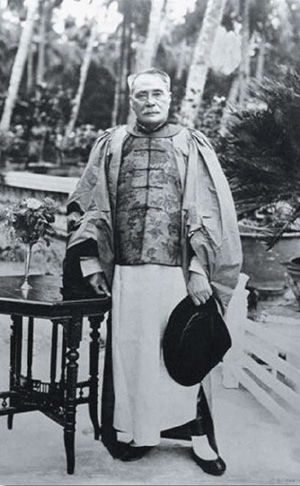
A dignified Loke Yew, wearing the Honorary Degree of Doctor's gown when he was conferred the prestigious title in 1916.

Degree Congregation of the University of Hong Kong

December 14, 1916, for 23 students and 5 honorary graduates --- another 4 would be added in the same year

The graduates are: 12 in Engineering - 傅秉常, 鄧應霖, 梁乃恒, 何永乾, 葉衍芳, 凌文禮, 韋榮翰, 韋榮駱, 黃泰初, Lau Chan, Lai Hau-yeung and Chan Iu-choo; 8 in Medicine – 周懷璋, 林宗揚, Cheah Tiang-eam, Cheong Chee-hai, Wong Hing-chuen, Teoh Cheng-toe, Teh Lean-swee and Lim Soon-kian; and 3 in Arts – 林棟, 李景康 and Li Tsok -lun.

University

March 11, 1912, the University of Hong Kong, teaching commenced in September, the university had three faculties: Medicine, Engineering and Arts, with a total of 71 students.

On March 16, 1910, Frederick Lugard, Governor, laid the foundation stone of the Main Building.


1946 Photo, the hall in the main building is seen damaged from the war

Medical School

October 1, 1887, the Hong Kong College of Medicine for Chinese (香港華人西醫書院)


This 1965 photo shows the location of the site of the medical school at the corner of Hollywood Street and Aberdeen Street